

AI-Powered Digital Democracy During Wartime
AI can help citizens find common ground, but high-stakes decisions like conscription and peace terms reveal the sharp limits of digital democracy.

I was inspired to write this post by a recent article, “Stop Shouting. Start Policymaking,” by Carl Miller and Beth Goldberg on AI Policy Perspectives (which is, in my opinion, one of the most interesting Substack blogs on AI and democracy). The article touches on the use of AI to further democratic processes, referring to examples from Taiwan, Bowling Green in southern Kentucky, and the UK, where AI has already been deployed to encourage civic conversations, present politicians with policy ideas, and help find common ground among citizens1.
Against this background, I started thinking about Ukraine, and in particular, about two of the most defining challenges the country faces in its war against Russia: when and under what conditions to end the war, and who should fight it. These are questions where public opinion is deeply fractured, and where I can clearly see the limits of digital democracy.
Who gets to vote on peace?
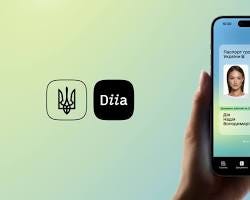
As far as e-democracy is concerned, Ukraine’s performance is impressive2. The state-run Diia app allows citizens to vote on issues of national significance. For example, as a result of a vote on the Diia app, Ukrainians changed the date when Christmas is celebrated from January 7th to December 25th3. It should be noted, though, that the platform’s polling and surveys are not yet AI-powered.
So, what if an AI-powered tool, similar to those used in Taiwan or Bowling Green, were used to help the people of Ukraine arrive at a common position on how the war should end?
Imagine Ukraine tries to put a peace deal with Russia to a vote using such a tool. On its face, this looks like a reasonable step: give the people who bear the burden of the war and die in it the ability to decide when to sign a deal, and on what conditions. But the first serious challenge is deciding who should vote.
Should it be only those Ukrainians currently living in Ukraine, who face the war and its consequences firsthand? Or all Ukrainians, including those who are abroad?
This is something many abstain from discussing because of the sensitivity of the issue. Many Ukrainians have settled in North America and Europe over almost five years of war. Some genuinely want to return to their home country, but many do not. The end of the war might mean their temporary residence permits and work authorizations expire, requiring them to go back. This does not make those who don’t want to return unpatriotic. It is simply a reality of life.
However, it does mean that Ukrainians can be driven by structurally different incentives when it comes to the question of ending the war. Those living inside Ukraine may want a swifter end, even one that involves painful concessions on sovereignty and territorial integrity. Meanwhile, those living outside, who do not feel the daily weight of the conflict, may favor a longer war aimed at the full restoration of Ukrainian territory.
If this scenario occurs, I do not think the government should extend the vote on ending the war to Ukrainians abroad. It would, in my view, be fairer to allow only those who immediately bear the burden of the war to decide how long it should last. Therefore, I fail to see an act of direct democracy (powered by AI and covering all Ukrainians both inside and outside the country) as a viable mechanism to answer how and under what conditions the war should end.
That said, this does not mean there is no scope for AI in this domain. The Carl Miller and Beth Goldberg’s article mentions Jigsaw’s Sensemaking4. This is an AI tool designed to help policymakers gather and understand public opinion at scale. In my opinion, the Ukrainian government could use something like this to better understand what society thinks about how the war should end, without requiring citizens to state their views publicly. This matters because, during wartime, many people would hesitate to reveal their true attitudes for fear of being labeled insufficiently patriotic. The Habermas Machine5, developed by Google and mentioned in the article, can also act as a mediator between people discussing divisive topics and could help identify common ground among Ukrainians (both inside and outside the country) on what a just end to the war might look like.
There is thus real scope for AI tools in understanding what Ukrainians think. I am, at the same time, more skeptical of using them to run a direct-democracy-style vote open to all Ukrainian citizens, regardless of where they live.
AI and military recruitment
As Carl Miller and Beth Goldberg note, trust is never a minor issue when it comes to AI and digital democracy6. This is especially so when it comes to the question of military recruitment.
These days, Ukraine (and to a large extend Russia) faces a shortage of manpower. The government has had no choice but to call hundreds of thousands of men to the frontline. The Constitution of Ukraine7 and other laws mandate that Ukrainian men, unless they fall under certain exceptions, must protect their homeland. I will not take a moral stance on this. The real cost of a “just” end to the war may be such that there are legitimate reasons not to take very patriotic stances on the matter, and the circumstances of this conflict differ from the wars that tend to get romanticized. I do believe that Ukrainians, on the whole, are very patriotic and courageous people and that the Ukrainian government, including its Ministry of Defense and Ministry of Digital Transformation, is doing more than what might be considered possible.
The question is whether AI-powered tools should be used to help the government recruit more people into the military. This was discussed in Ukrainian policy circles. It was even proposed to allow military service subpoenas to be sent via the already mentioned Diia app. The Ministry of Digital Transformation refused8 for the reason that using the platform for this purpose (however legitimate) would undermine public trust in Diia as a whole. If citizens come to associate e-governance with conscription notices, they will trust it less for everything else.
In my opinion this case is very illustrative in that sometimes using AI for egovernance purposes might undermine trust in technologies even when the reason for so doing is legitimate in itself.
At the same time, there are cases where AI can strengthen, rather than erode, trust in military-related services. Very recently, a new service called For Defenders and Their Families was launched on the Diia portal, allowing military personnel, veterans, and families of fallen defenders to submit a single application to access multiple government services at once9. One can imagine agentic AI being deployed in the future to make this process even more efficient.
Conclusion
As illustrated by Carl Miller and Beth Goldberg in their AI Policy Perspectives article AI-powered tools can be genuinely useful in helping governments understand public opinion, find common ground, and deliver services more effectively. However, looking at it from the perspective of the war in Ukraine where very sensitive decisions need to be made as to how to end the war and who should die in it, I also see the challenges that the above authors mention. Direct democracy using AI tools does not always appropriately address the situation and public trust does not always sit well with the AI tools.
Author’s Note on AI Collaboration
The content and ideas in this article are entirely the work of the author. Anthropic’s Claude and Google Gemini were used solely as light editorial tools to verify grammar and improve the overall flow of the prose. All creative direction, structural decisions, and factual verifications were performed exclusively by the human author.

Digital State UA. (2025). Україна серед глобальних лідерів GovTech у рейтингу Світового банку. https://digitalstate.gov.ua/news/govtech/ukrayina-sered-hlobalnykh-lideriv-govtech-u-reytynhu-svitovoho-banku
Global Government Technology Centre in Kyiv. (n.d.). Ukraine’s GovTech enhancing e-democracy ecosystem. https://www.kyivgovtechcentre.org/ukraines_govtech_enhancing_edemocracy_ecosystem
Jigsaw. (n.d.). Sensemaking by Jigsaw - A Google AI Proof of Concept. https://jigsaw-code.github.io/sensemaking-tools/
Tessler, M. H., Bakker, M. A., et al. (2024, October 18). AI can help humans find common ground in democratic deliberation. Science. https://www.science.org/doi/10.1126/science.adq2852
AI Policy Perspectives, “Stop Shouting. Start Policymaking.”
Constitute Project. (2019). Ukraine 1996 (rev. 2019). https://www.constituteproject.org/constitution/Ukraine_2019
Mezha. (2025, July 31). Ukraine approves military summons by mail, rejects electronic notices. https://mezha.net/eng/bukvy/ukraine-approves-military-summons-by-mail-rejects-electronic-notices/
United Nations Development Programme. (2026, June 18). New comprehensive service for veterans and their families launched on Diia portal. https://www.undp.org/ukraine/news/new-comprehensive-service-veterans-and-their-families-launched-diia-portal
Really enjoyed this piece, Taras.
What struck me is that the hardest questions in your examples are not actually about AI. AI can help aggregate preferences, reveal common ground, and improve deliberation. But when the question becomes who gets to vote, who bears the costs, and who gets to decide, we are no longer dealing with an information problem—we are dealing with a power problem.
In a sense, your wartime examples reveal the limits of digital democracy not because AI is insufficient, but because democratic procedures eventually run into underlying power structures.
This connects strongly with a theme I’ve been exploring in my Rethinking the State series: states are often treated as moral actors, but they may be better understood as power-organizing systems. AI might help us hear society more clearly, but it does not tell us how power should be allocated when different groups bear radically different costs.
Looking forward to reading more of your work on AI, power, and governance.